 VIETNAMESE
PINEAPPLE FIBER UNEVENNESS: A TECHNICAL RISK OR AN ELEMENT TO BE REDESIGNED?
In the current wave of sustainable materials development, natural pineapple fiber is receiving widespread attention. Many businesses see it as a potential alternative to traditional synthetic fibers. However, besides its ecological benefits, pineapple fiber unevenness is often considered a major technical barrier in modern textile manufacturing.
Therefore, a critical question arises: is this variation truly a risk that we must eliminate? Or is it a material characteristic that we need to systematically redesign? Answering this question correctly will directly determine the long-term commercial viability of pineapple fiber.
Nội dung chính:
Pineapple fiber is a natural resource instead of a standardized industrial product
Unlike synthetic fibers made in highly controlled lab environments, natural fiber comes directly from pineapple leaves. These leaves are a common agricultural byproduct harvested after fruit collection. As a result, the physical properties of raw fiber are heavily influenced by multiple natural factors.
Main causes of natural variations
- Specific soil conditions and regional climates shape the crops.
- Different plant varieties affect the natural growth cycle.
- Harvesting times combine with specific extraction methods.
- Initial primary processing alters raw treatment outcomes.
Consequently, an absolutely uniform natural fiber does not exist. This variation is a universal characteristic shared by almost all bio-materials on earth.
Why is material variation often viewed as a technical risk?
In industrial textile production systems, material stability acts as a key factor. Therefore, pineapple fiber unevenness can create several operational challenges during manufacturing:
- The issue causes deviations in fiber fineness and fiber length.
- It leads to yarn breakage during the spinning process.
- Tension control becomes highly difficult on the factory floor.
- Modern looms experience fluctuations in fabric strength and final surface handfeel.
- Defect rates increase if factories apply standard machinery designed for man-made fibers.
However, the core issue does not lie within the material itself. Instead, the real challenge comes from applying a rigid linear mindset to a non-linear natural material.
Rethinking the problem: do we truly need absolute uniformity?
In reality, many high-value sustainable materials still possess a certain degree of natural variation. Typical examples include premium fibers such as wool, linen, or silk. Nevertheless, the only difference is that the global textile industry has learned how to design processes around those unique characteristics.
Therefore, regarding the pineapple fiber production puzzle, we must reframe our core question:
Are we trying to force a natural material to adapt to old machinery? Or are we designing a new production process that fits the material?
Redesigning instead of eliminating: a more sustainable approach
Grouping and controlling fiber by technical categories
Instead of trying to completely eliminate natural characteristics, many advanced material developers choose a more optimal solution. Specifically, they implement the following steps:
- Technical teams actively group fibers based on specific length and fineness.
- Companies establish clear technical thresholds for each specific end-use application.
- Factories standardize quality at a “fit-for-purpose” level instead of chasing absolute perfection.
Indeed, this approach helps minimize material waste significantly. At the same time, businesses can successfully preserve the inherent natural characteristics of natural pineapple fiber.
Blending fibers as an optimal process solution
In practical manufacturing, raw pineapple fiber is rarely used alone at a 100% ratio. Alternatively, blending it with cotton, viscose, or other regenerated fibers brings massive benefits:
- The practice significantly increases stability during the industrial spinning process.
- Mixing fibers improves softness and enhances the final fabric surface texture.
- Blends optimize processing efficiency on existing conventional weaving lines.
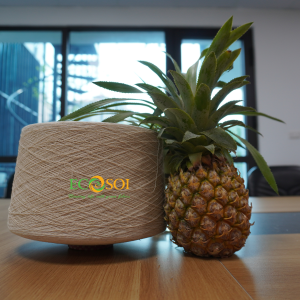
Furthermore, factories should design the blending ratio based on the final usage of the product. It is best to avoid rigidly following a fixed formula.
The vital role of material testing in risk management
For natural fibers, the testing phase is definitely not an optional step. On the contrary, it acts as the absolute center of the entire product development workflow.
What does technical material testing help businesses control?
- Testing monitors the mechanical stability of the finished fabric after multiple washes.
- It tracks dimensional changes based on real-world usage conditions.
- Evaluators measure breathability and safe contact with sensitive human skin.
- The process ensures quality repeatability and consistency across different production batches.
Thanks to these intuitive data insights, businesses can make accurate decisions. Consequently, they can reduce operational risks to the lowest possible level.
Transforming natural variations into a manageable variable
For business partners, the primary goal is not to find flawless material. Instead, they require clear and predictable criteria:
- Partners look for predictability of the raw material quality right from the input phase.
- Stability must stay strictly within the permitted technical framework.
- Suppliers need to provide absolute transparency regarding the application limits of the material.
When brands clarify these factors from the beginning, pineapple fiber unevenness officially becomes a fully manageable variable.
True value lies in real-world user experience
From the end-consumer perspective, the actual feeling during daily usage is the deciding factor:
- Consumers check if the natural clothing is breathable enough for daily activities.
- Wearers observe if the material causes any irritation to sensitive skin types.
- Buyers want to know if the product garment maintains its shape after long-term use.
In many cases, a natural fiber structure that is not completely uniform actually creates a unique artistic depth on the fabric surface. Ultimately, this characteristic delivers a completely premium experience compared to boring, identical synthetic textiles.
How Ecosoi approaches the natural material puzzle
At Ecosoi, pineapple fiber is never treated as a raw material that needs forced standardization. Instead, we approach this challenge through an integrated and synchronous strategy:
- Our team focuses on closed-loop development from fiber selection to spinning and fabric weaving.
- Engineers design flexible material structures tailored to each practical application.
- The factory prioritizes long-term functional performance over theoretical ideal parameters.
As a result, this methodology helps Ecosoi transform technical challenges into valuable input data for our material design process.
Explore more: Ecosoi pineapple yarn
Conclusion: risk only appears when there is a lack of material understanding
In conclusion, pineapple fiber unevenness is not a technical defect. Rather, it is a natural characteristic that we must understand correctly, measure accurately, and redesign responsibly.
When businesses develop materials in parallel with appropriate processes, pineapple fiber will become a highly viable solution for the global sustainable textile industry.
👉 If you are considering applying this material to your new project, let us start with the textile material testing and structural design phase today.