 VIETNAMESE
Natural Raw Materials Are Not as “Easy” as We Think
In the global green transition trend, the phrase “sustainable natural raw materials” is often considered a safety certificate for fashion brands. These eco-friendly materials always bring a sense of friendliness and safety. Consequently, businesses easily gain absolute trust from modern consumers.
However, the reality of manufacturing is not that simple. Natural raw materials are not always “easy” or absolutely perfect. If they are not managed scientifically, blind exploitation will leave massive consequences. Truly, it unintentionally creates a heavy reverse pressure on both the environment and society.
This is exactly why export brands targeting the European market (EU) are actively changing. Therefore, they must thoroughly re-examine their entire sustainable textile supply chain.
Nội dung chính:
The Essence of Sustainable Natural Raw Materials: Perception or Reality?
Many businesses traditionally assume that any product labeled “natural” is automatically good. They firmly believe that these items are inherently friendly to the environment. Nevertheless, comprehensive reports from the Textile Exchange organization clearly point to the opposite.
The true nature of sustainable natural raw materials depends entirely on the operational chain. Crucially, the deciding factors include farming methods, harvesting, chemical processing, and the distribution process. Many traditional raw fibers still cause great harm to the ecosystem if production lacks strict control.
The most painful issues frequently encountered include:
- Resource depletion: The situation of excessive freshwater consumption during cultivation. Furthermore, the abuse of pesticides severely depletes soil fertility.
- Social risks: A critical lack of transparency regarding labor origins. Thus, the lives and livelihoods of local farmers in raw material regions are not guaranteed.
- Large carbon footprint: Raw fiber treatment processes often rely on heavy industrial chemicals. Consequently, this practice causes serious pollution to wastewater sources.
Therefore, a “natural” origin is merely a necessary starting condition. This single factor is absolutely not the final conclusion for a truly green product.
When Natural Materials in Textiles Turn Into Major ESG Risks
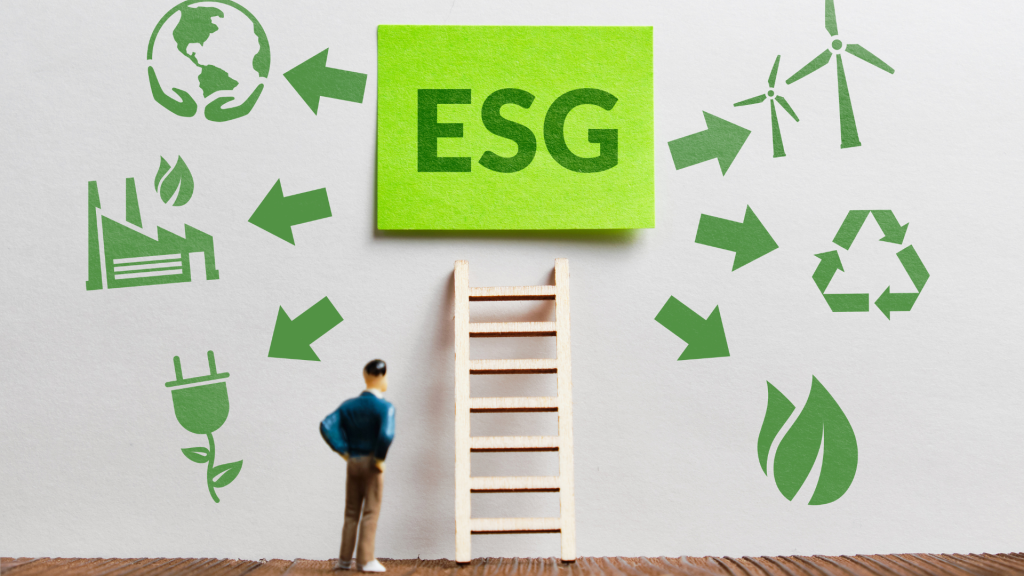
For Vietnamese textile enterprises, meeting international criteria is now mandatory. Deeply understanding ESG in the textile industry effectively helps businesses open doors to international markets. Indeed, this is the essential ticket to access the demanding European Union (EU) market.
On the contrary, a source of natural materials in textiles will instantly turn into a major risk if a brand falls into the following cases:
- The enterprise cannot clearly trace the origin of raw materials from the farm to the factory.
- The supply chain lacks verified raw data regarding carbon emissions, chemical usage, and energy consumption levels.
- The manufacturing process fails to meet strict social responsibility standards, leaving the local ecosystem unprotected.
According to recommendations from the Food and Agriculture Organization of the United Nations (FAO), an opaque agricultural supply chain is highly dangerous. It acts as the leading cause of long-term ecological imbalance. If brands blindly chase keywords like “organic” or “natural” without technical verification, they will easily fall into the dangerous trap of greenwashing.
The Issue Is Not the Material, It Is the Supply Chain Management Solution
A raw material source is only truly green when it is strictly managed. Businesses must maintain excellent control over materials throughout the entire product lifecycle. The choice of materials must be based on the practical application context. At the same time, it needs to completely fit industrial production capacity. We must actively avoid chasing short-term, emotional trends.
To successfully transition toward sustainable fashion, B2B brands need to focus on solving three major equations:
- The traceability challenge: Origin data must be digitized and fully transparent. This data system must be completely ready for independent third parties to verify.
- Technical stability: Natural raw materials always fluctuate according to harvest seasons and crop periods. Therefore, the supplier must possess strong R&D capabilities. This advantage helps stabilize technical specifications for large-scale industrial weaving machines.
- Scalability capacity: Businesses need to overcome the weakness of small, fragmented manual models. From there, the factory can guarantee a uniform, large-volume supply capacity according to commercial orders.
How ECOSOI Tames Natural Materials With a Cautious Mindset
Deeply understanding the bottlenecks of the industry, ECOSOI maintains its own distinct path. We never communicate about natural fibers as an “absolutely perfect solution.” Instead, ECOSOI always approaches agricultural by-products with a highly rigorous management mindset:
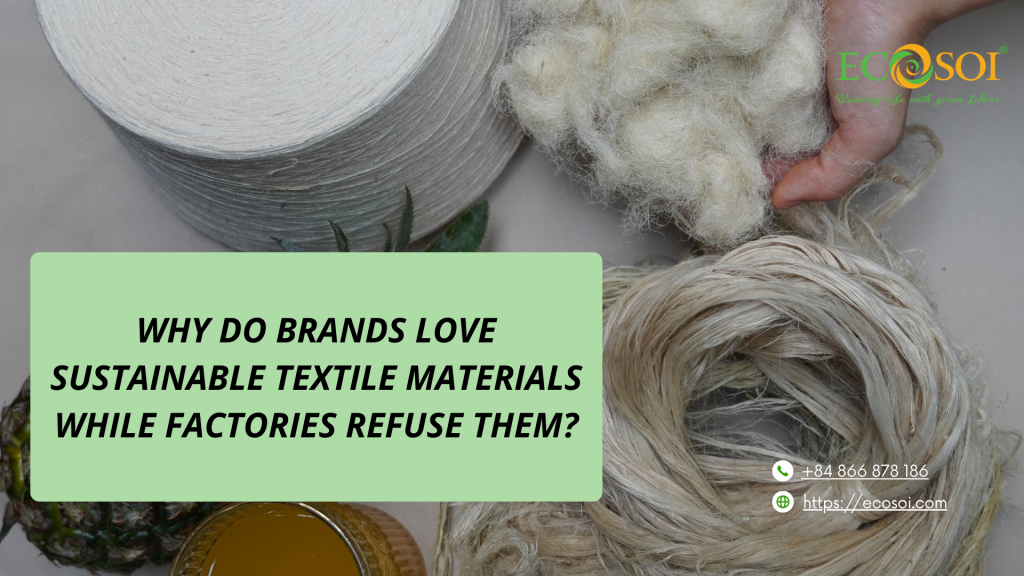
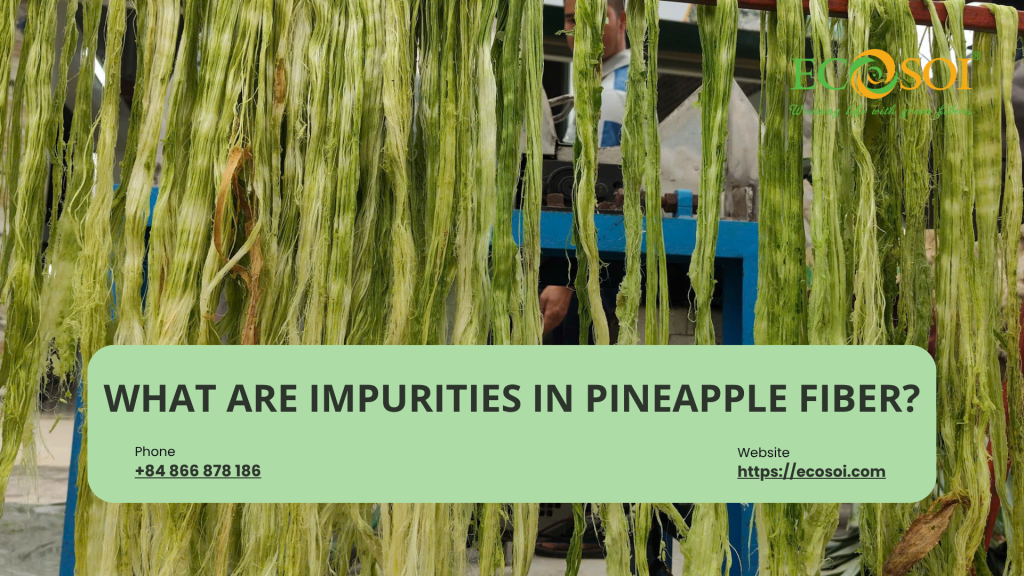
- Measuring instead of feeling: ECOSOI proudly owns an exclusive mechanical extraction technology. We treat and degum our fibers entirely with clean water. Specifically, ECOSOI commits to keeping the residual gum rate under 10% on our premium, natural Q1 raw fiber lines. This green process directly reduces a large amount of CO2 emissions every year by preventing traditional leaf-burning habits among farmers. Simultaneously, this technology fully protects the soil biology.
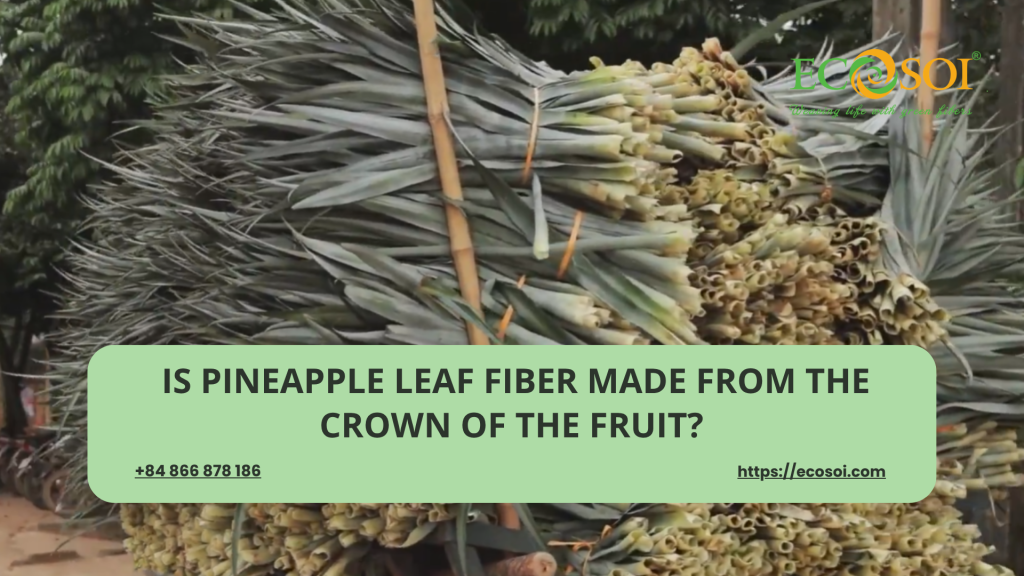
- Being upfront about material limitations: We actively advise our B2B partners about the characteristic roughness of original pineapple fiber. Therefore, to optimize flatness, softness, and breathability, ECOSOI has successfully researched scientifically blended yarn lines. Typical examples include pineapple fiber mixed with cotton (at ratios of 20/80 or 40/60) or woven pineapple fiber mixed with spandex for a comfortable, light stretch.
Thanks to this evidence-based approach, ECOSOI has harvested great success. We have become a strategic partner for many prominent brands exporting. ECOSOI proudly accompanies premium design studios. As a wonderful first step, we have successfully brought Vietnamese eco-textile products to perform in international markets.
Conclusion: Understanding the True Nature to Take Your Brand Further
Sustainable natural raw materials are never simple to manage. However, that reality does not reduce their immense strategic value. When a business successfully controls its supply chain, everything changes completely. With transparent data, natural assets will become a sharp competitive weapon in the circular economy era. This is the optimal solution for the future.
For the future fashion industry, purchasing standards have shifted permanently. The big question from professional buyers is no longer: “Is this material natural?”. Instead, the ultimate life-or-death question must be: “Does this raw material traceability chain have enough verified data to fully prove its ESG responsibility?”.
Contact ECOSOI today to standardize industrial-grade green raw materials for your business: