 VIETNAMESE
Irregularity of Natural Raw Materials: A Weakness or the True Essence?
In the industrial textile sector, absolute uniformity has long been the definitive benchmark for product quality. According to this standard, fibers must be identical, fabrics must be stable, and colors across batches must be perfectly consistent. However, as businesses shift toward eco-weaving trends, the irregularity of natural raw materials has become a complex puzzle for textile engineers.
This reality raises a core question for the sustainable supply chain. Is this variation a technical flaw, or is it an organic essence that we must understand and manage properly?
Nội dung chính:
Why Can Sustainable Raw Materials Never Achieve Absolute Uniformity?
Synthetic fibers are extruded from petroleum, so they possess a naturally high level of consistency. In contrast, sustainable raw materials with a biological origin are directly affected by the natural environment. Factors such as soil conditions, climate, harvest seasons, and farming methods explicitly dictate the physical traits of raw fiber.
According to the Textile Exchange organization, variations in natural materials in textiles usually appear in three main areas:
- The natural length, fineness of the raw fiber, and the ultimate fiber bonding strength.
- The color absorption capacity and the organic, rustic luster of each harvested batch.
- The texture of the fabric grain after undergoing the mechanical degumming process.
Therefore, imposing rigid mechanical standards of uniformity onto eco-friendly materials is inappropriate. This action directly contradicts the biological nature of living matter.
The ESG Perspective: The Market Demands Transparency, Not Perfection
For fashion brands, meeting global standards creates immense structural pressure. Nevertheless, the absolute perfection of a material is not the deciding factor. Strict international markets, such as the European Union (EU), do not reject an enterprise simply because its natural fibers show biological variation. Instead, what they truly demand is a robust textile traceability capacity and verifiable data honesty.
In reality, differences between fiber batches only become a risk when a business deliberately conceals them. Risks also arise if the supply chain lacks clear classification criteria from the beginning. According to ISO quality management guidelines, controlling and adapting to biological variation is highly crucial. Truly, this proactive solution is far more optimal than trying to eliminate variation by force.
Core Message: When the irregularity of natural raw materials is precisely measured using raw data, it ceases to be a technical weakness. On the contrary, it serves as invaluable proof of regional origin and the brand’s ecological responsibility.
Design Mindset: Turning “Imperfection” Into Unique Aesthetic Value
Mass industrial manufacturing always demands absolute uniformity. On the contrary, independent designers and premium fashion studios deeply appreciate subtle deviations in fabric surfaces. For these experts, an uneven fabric texture is a golden material to create a distinct brand signature. Many visionary designers constantly cherish the unique characteristics of natural fiber quality:
- Spontaneous fiber grains: This trait creates visual depth and a beautifully rustic feel for the garment.
- Subtle color shifts: This variation confirms that the fabric underwent eco-friendly biological processing without overusing toxic bleaching chemicals.
- Non-repetitive textures: This asset delivers a sense of authentic craftsmanship, local heritage, and a deep material narrative.
Concretely, this is a premium artistic value that helps shape limited-edition collections. Identical, chemically processed industrial fibers can never recreate this organic prestige. When a brand celebrates controlled imperfection, natural fiber quality is redefined. The ultimate value of a garment lies in the rustic story told throughout the product lifecycle.
How ECOSOI Responsibly Controls Pineapple Fiber Variations
Deeply understanding this technical challenge, ECOSOI never chooses to hide physical limitations. Instead, we successfully “tame” the material through robust R&D capabilities and a rigorous sustainable supply chain management process:
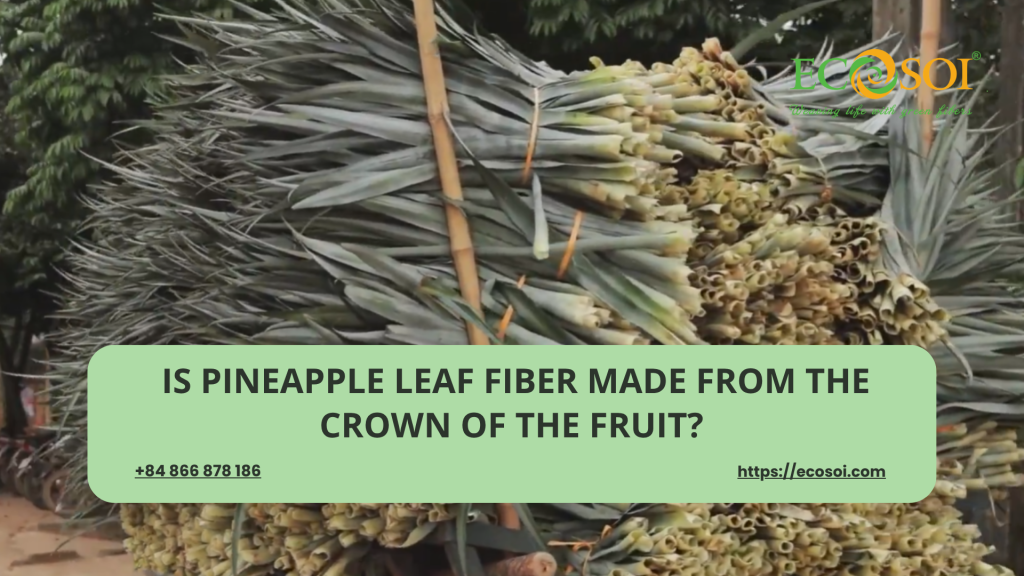
- Industrial Standard Classification: ECOSOI extracts pineapple leaves using exclusive mechanical technology and degums the fibers entirely with clean water. Afterward, the fibers are strictly classified into Q1, Q2, and Q3 grades based on application needs. Among these, our premium Q1 lines meet industrial standards with a natural milky-white color and a residual gum rate of under 10%.
- Stabilizing Technical Specifications via Scientific Blending: To resolve the pain point of fiber breakage during large-scale automated weaving, we developed smart blending solutions. ECOSOI offers woven and knitted yarn cones expertly blended with cotton at ratios of 20/80 or 40/60 (available in 10Ne and 20Ne counts). This strategy optimizes fabric flatness, softness, and compatibility with high-speed industrial looms.

This evidence-based approach allows ECOSOI to confidently partner with major global brands. We effectively help our partners overcome technical weaving barriers and navigate intense ESG in the fashion industry pressures.
Explore more: HOW TO SPOT A HIGH-QUALITY PINEAPPLE FIBER BATCH
Conclusion
The irregularity of natural raw materials is never a technical defect. Instead, it is the defining essence of living materials. The ultimate challenge of circular fashion does not lie in the variation of the material itself. Rather, the true test lies in how businesses measure, expect, and apply those unique variations.
When managed with high responsibility, irregularities do not diminish product value. On the contrary, they act as a unique certificate that strongly affirms the brand’s authentic sustainable values.
Contact ECOSOI today to standardize industrial-grade green raw materials for your enterprise: