 VIETNAMESE
3 common issues in natural fiber weaving and Ecosoi’s solutions
Natural fibers such as cotton, linen, pineapple leaf fiber, and hemp are becoming more popular thanks to their sustainability and bio-based origin.
However, producing and weaving natural fibers still face many challenges related to the environment, technology, and product quality. If these issues are not handled well, they can reduce the sustainability advantage of natural materials. At the same time, they directly affect B2B buyers and end consumers.
Nội dung chính:
High water consumption and wastewater treatment
The issue
Fiber processing, dyeing, and finishing require a large amount of water. In addition, wastewater after dyeing often contains dyes and chemicals that are difficult to decompose.
If this wastewater is discharged without proper treatment, it can seriously pollute local ecosystems and water sources. Therefore, this creates not only environmental risks but also legal and brand risks for suppliers.
Ecosoi’s solution
- Reusing treated water for agriculture: Instead of discharging wastewater, Ecosoi treats it through biological and mechanical filtration systems until it meets safety standards. After that, the treated water is reused for irrigation by local farmers around the production area.
As a result, this solution reduces pressure on clean water sources and creates long-term community value.

- Transparent water data: Ecosoi regularly monitors water usage and reuse. This data is shared with B2B partners to support ESG reporting and supply chain evaluations.
Thanks to these actions, Ecosoi not only reduces operating costs but also eases pressure on local water resources. At the same time, the company strengthens relationships with farming communities, which play a key role in raw material supply and labor. In addition, this approach improves competitiveness with international clients who prioritize ESG standards.
Unstable raw material supply
The issue
One of the biggest challenges in the natural fiber industry is unstable raw material supply. Agricultural materials depend heavily on weather and farming conditions.
Droughts, floods, or diseases can seriously affect the yield of cotton, flax, or silkworm farming.
In addition, long production cycles create further difficulties. From planting to harvesting, cotton fiber can take 5 to 6 months. Meanwhile, silk production requires careful and time-consuming silkworm care. As a result, textile companies often struggle to respond to sudden market demand.
Moreover, the initial investment cost for growing cotton, flax, or raising silkworms is high. It requires large land areas and significant human resources.
Ecosoi’s solution
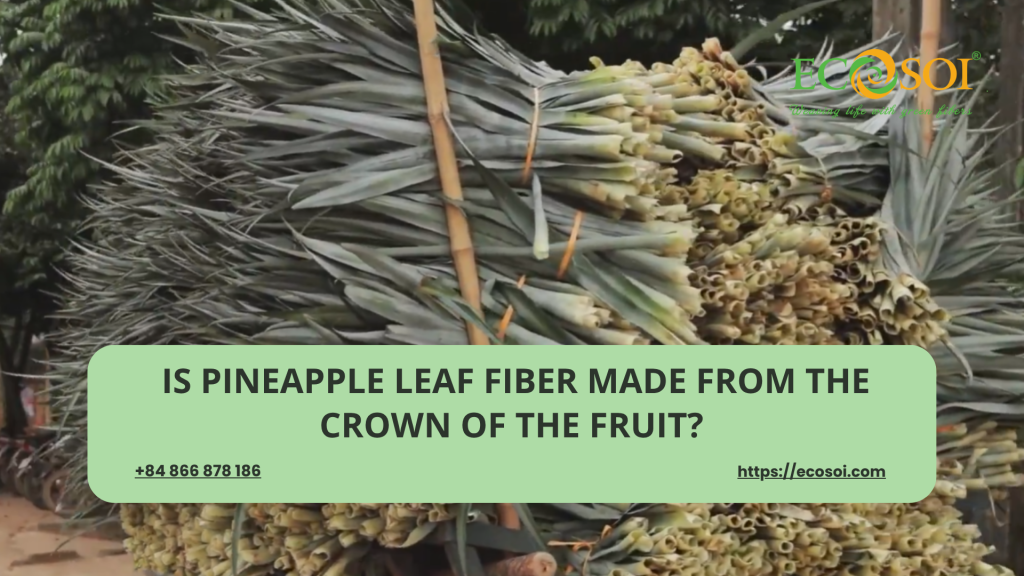
Ecosoi uses a stable and abundant raw material source: pineapple agricultural by-products.
Vietnam has around 52,000 hectares of pineapple plantations, producing nearly 1 million tons of pineapples each year. After harvesting the fruit, farmers usually discard millions of tons of pineapple leaves by shredding and burning them in the fields.

Ecosoi turns this massive waste into valuable raw materials. Pineapple leaves are agricultural by-products, so they do not require extra farming costs or additional cultivation time. Therefore, the supply is stable throughout the year and less affected by weather or farming cycles.
The company works with major pineapple-growing regions such as Nghe An and Thanh Hoa. This creates additional jobs and income for local farmers.
Similarly, Ecosoi’s banana fiber is made from banana trunks after harvest, another abundant resource in Vietnam.
By using agricultural waste, Ecosoi not only solves supply challenges but also helps protect the environment. At the same time, it reduces open burning waste, which causes air pollution.
High production costs and expensive pricing
The issue
A major drawback of traditional natural fibers is their high production cost and selling price.
The entire process, from planting and care to harvesting and fiber processing, requires a lot of labor and time.
Silk fiber is often called the “queen” of the textile industry and has a very high price in the global market. Although mulberry silk accounts for about 95% of global silk production, its price remains high due to complex processes and low yield rates.
Similarly, 100% cotton fabric is much more expensive than blended fabrics or synthetic fibers. As a result, many textile companies shift to synthetic fibers such as polyester or nylon, which are petroleum-based and cheaper, but harmful to the environment.
Ecosoi’s solution
Ecosoi offers a more economical solution by using agricultural waste materials. Since pineapple leaves and banana trunks are waste products, the input material cost is significantly lower than growing cotton or raising silkworms from the beginning.

The production process is fully mechanical. Ecosoi uses fiber extraction machines and chemical-free separation methods to speed up production. As a result, this reduces production costs and minimizes industrial waste.
After fiber extraction, the remaining residues can be reused as organic fertilizer or biofuel. This maximizes the economic efficiency of the entire process. Thanks to this approach, Ecosoi can provide high-quality natural fibers at more competitive prices.
Ecosoi’s pineapple leaf fiber has high durability and good tensile strength. In addition, pineapple fiber fabrics absorb dyes well and retain color effectively. This creates attractive fabrics with a wide range of colors. These qualities increase product value and help offset initial costs.
With a long-term vision, as production volume increases and processes are further optimized, the cost of pineapple fiber and banana fiber will gradually decrease. This creates a strong competitive advantage in the international market.
Ecosoi – A pioneer in Vietnam’s green textile industry
With a mission to promote green transformation in the textile industry, Ecosoi is proud to be one of the pioneering companies in Vietnam that research, produce, and supply fibers, yarns, and fabrics from pineapple leaves and banana trunks. These materials are natural, renewable, and environmentally friendly.
Ecosoi’s products have reached many countries such as South Korea, India, Japan, and China. In Vietnam, designers like La Pham and Pham Ngoc Anh have chosen Ecosoi’s natural fabrics for impressive collections at fashion weeks. This proves that pineapple fiber and banana fiber are not only sustainable but also meet high aesthetic standards.


Ecosoi believes that major change starts from small choices. Raw materials are where the sustainability story begins. Therefore, the company is committed to supporting domestic and international businesses in replacing traditional materials with bio-based solutions. In doing so, Ecosoi contributes to a healthier fashion industry for people and a safer planet.
Conclusion
The three main issues in natural fiber weaving—water consumption and wastewater treatment, unstable supply, and high costs—can be effectively addressed through Ecosoi’s pineapple fiber and banana fiber solutions.
By using agricultural waste, applying environmentally friendly production processes, and delivering high-quality products, Ecosoi is becoming a key driver of sustainable fashion in Vietnam.
As the global textile industry accelerates its green transition, shifting to natural fibers from sustainable sources is not only an environmental responsibility but also a major business opportunity. Ecosoi is opening a new path, turning challenges into competitive advantages for Vietnam’s textile industry on the global stage.