 VIETNAMESE
What Decides Pineapple Fiber Quality? Material or Process?
In the sustainable textile trend, pineapple leaf fiber is rising as an extremely potential material. However, even with the same name, pineapple fiber quality varies widely on the market.
Therefore, this raises a core question for B2B companies and buyers. Is this quality decided mostly by the raw materials or by the processing method? This article will analyze both factors to help you understand the true nature of this material.
Nội dung chính:
What is Pineapple Fiber Quality and Why is it Hard to Judge?
Factories make synthetic yarns in strictly controlled spaces. Conversely, pineapple yarn has an agricultural biological origin. Therefore, nature, farming habits, and processing methods affect it all at once.
Thus, pineapple fiber quality is not just a single simple number. Instead, it is a mix of fiber uniformity, mechanical strength, cleanliness, and spinning ease. According to the ISO framework, a material only achieves high quality when it perfectly meets its end-use purpose.
Raw Materials: The Initial Foundation
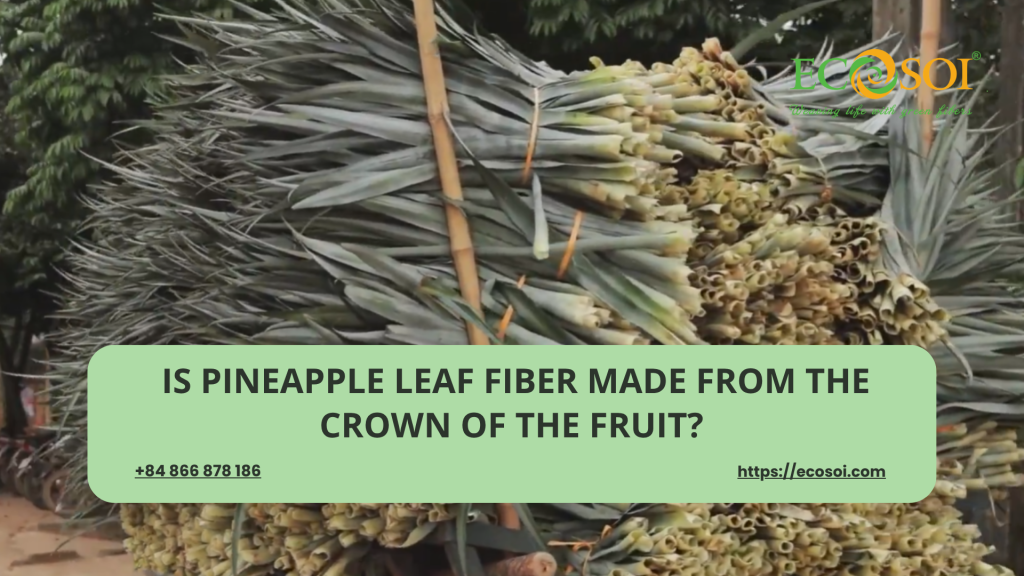
First, pineapple fiber comes from leaves left over after the fruit harvest. The plant breed, soil conditions, and harvest time directly affect the leaf quality.

For example, using leaves that are too young or too old brings huge risks. It can lead to weak fibers, uneven lengths, and too much lignin. This proves that raw materials set the initial quality potential, but they are not the final deciding factor.
Besides that, the collection source is also very important. Scattered gathering makes the quality swing wildly between batches. However, even with excellent raw materials, the final yarn can still fail if the processing method is wrong.
The Processing Step: Shaping the Actual Quality
The extraction and biological treatment steps strictly decide the final fiber structure. This highlights the vital role of the pineapple fiber production process.
Fiber Extraction – The Important First Step
Factories can extract fiber using mechanical tools or special enzymes. If done incorrectly, the fiber will break easily and trap a lot of trash. According to ASTM standards, controlling the mechanical force is the ultimate key to protecting natural fibers.
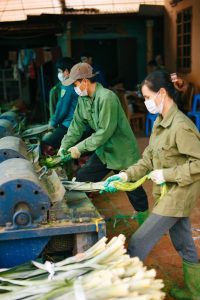
Cleaning and Biological Control
Pineapple fiber contains good cellulose, along with bad hemicellulose and lignin that factories must remove. A precise microbe treatment makes the fiber soft, boosts its spinning ability, and totally removes bad smells. Conversely, using strong chemical bleach will completely destroy the fiber’s natural strength.
Material vs. Process: Which Factor is More Important?
The answer is not a simple “either-or” choice. Instead, it is a perfect combination of both. Real textile production proves this clearly:
-
First, good materials combined with a bad process will create waste yarn.
-
Second, average materials combined with an excellent process still create stable yarn.
-
Finally, excellent materials combined with a standard process create high-quality yarn.
Therefore, the process is a lever that boosts value, or a knife that destroys it. According to the UN Environment Programme (UNEP), sustainable materials only hold true value when their process is clear and verifiable.
Market View: What Should B2B and B2C Buyers Note?
For B2B clients, stability is a matter of life or death. Businesses need a fiber source that runs smoothly on current machines and keeps an even quality across batches. More importantly, process data must be fully transparent to support ESG reports.
For B2C buyers, you must avoid expecting pineapple yarn to feel smooth like silk right from the start. Understanding its natural traits correctly helps you judge products fairly and use them much longer.
Ecosoi: Mastering Materials and Standardizing Processes
At Ecosoi, we deeply understand the link between materials and processes. We absolutely do not rely on natural luck to gamble on pineapple fiber quality.
Instead, Ecosoi actively sets up standard leaf collection zones. Then, we combine this with our exclusive biological fiber processing tech. Specifically, to solve the stability puzzle for factories, Ecosoi strongly develops flexible blended yarns.
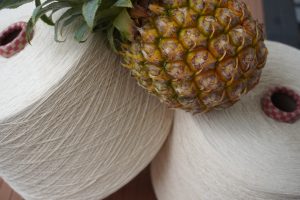
By mixing pineapple yarn with cotton, hemp, or linen in exact technical ratios, we offer a perfect solution. Ultimately, our materials offer extreme uniformity, easy processing, and 100% clear ESG data. This ensures top-tier yarn quality control.
Conclusion
In conclusion, pineapple fiber quality is a harmony between rich raw materials and a highly scientific process. When businesses and buyers understand this, we will build a truly sustainable textile industry instead of empty “greenwashing” campaigns.
Is your business looking for a blended pineapple yarn source with strict quality control and clear data? 👉 Contact Ecosoi right now via our website to receive a Technical Data Sheet (TDS) and totally free material samples!
Let’s spread the truest sustainable values together with Ecosoi. 👉 Follow the Ecosoi Fanpage to catch more deep knowledge about fashion and the environment!