 VIETNAMESE
WHAT IS A CARBON FOOTPRINT?
A carbon footprint represents the total greenhouse gas emissions linked to an activity, product, company, or individual. Experts usually measure this impact in kilograms or tons of carbon dioxide equivalent CO2.
In the textile sector, this metric receives growing attention. After all, garments do not generate emissions only during factory sewing. Instead, harmful gases arise from farming, spinning, weaving, dyeing, shipping, customer use, and final disposal.
Therefore, calling an item “low carbon” based only on raw material is not enough. To gain an accurate evaluation, we must examine a clearly defined product life cycle.
Nội dung chính:
What is a carbon footprint and how is it measured?
At its core, a carbon footprint tracks the total greenhouse gas output of an activity or item.
Different greenhouse gases trap heat in the atmosphere at different rates. For this reason, scientists convert them into a single common unit known as CO2.
For commercial products, the ISO 14067:2018 standard outlines the rules for measuring and reporting carbon data. In addition, this standard relies directly on the principles of Life Cycle Assessment (LCA).
This framework leads to an important point. Measuring a carbon impact is not just counting factory exhaust. Instead, analysts must set a clear calculation boundary beforehand. For example, one study may only review farm inputs up to the factory gate. In contrast, another study might track the entire product life cycle. Therefore, people should only compare two footprint numbers when boundaries, functional units, and methods match.
Where does a textile carbon footprint come from?
Textile manufacturing involves a very long supply chain. Indeed, a single shirt passes through many steps before reaching the wearer. Each stage creates distinct emission sources:
- Raw materials: This marks the starting point of the chain. Depending on the material, emissions come from farming, resource extraction, or waste handling. Thus, fiber choice affects the total footprint. However, green labels like “natural” or “recycled” do not reveal the full picture without proof.
- Spinning and weaving: Next, workers spin fibers into yarns and knit or weave them into cloth. These mechanical steps consume power and fuel. The local energy mix also changes the emission output. As a result, two mills using the same crop can yield very different numbers.
- Dyeing and finishing: Dyeing, washing, and finishing cloth require large amounts of water, heat, and chemicals. Therefore, researchers must count these steps whenever they fall inside the project scope.
- Transportation: Raw materials often travel across multiple borders before assembly finishes. Consequently, shipping distances and freight modes add to total supply chain emissions.
- Consumer use and disposal: A product impact does not stop at the factory gate. Home washing, drying, and final disposal also produce emissions. In fact, reports from the European Environment Agency show that consumer laundry and waste burning form major parts of textile emissions.
Why must the textile industry care about its carbon footprint?
The massive scale of the textile sector means emissions cannot remain just a marketing topic. According to the European Environment Agency, textiles bought by EU households in 2022 generated around 159 million tons of CO2. That equals roughly 355 kg of CO2 for each person. This figure does not mean every shirt carries a fixed emission rate. Rather, it reveals that material choices across millions of garments create a huge collective impact.
Therefore, textile businesses must understand verifiable environmental data instead of relying on vague “eco” buzzwords.
Does a natural material always have a lower carbon footprint?
We cannot judge true climate impact based solely on raw origin. In fact, this remains a very common industry misunderstanding.
The word “natural” describes where a fiber comes from. However, it does not reveal the total emissions generated across a product lifespan. A natural fiber still requires farming energy, clean water, global freight, and chemical finishing. Similarly, a recycled yarn does not automatically show the same footprint in every case.
Therefore, brands should ask a better question: How many emissions does this material create within its measured life cycle? To answer that, companies need verified data. For this reason, carbon claims must always disclose the test method, project boundary, and original data source.
How does a carbon footprint differ from general sustainability?
Fashion brands often mix up these two concepts. A carbon footprint measures only one metric: the impact on climate change. The ISO 14067 standard confirms that product carbon metrics focus exclusively on climate warming. In contrast, this standard does not measure social impact, fair wages, or broader ecological damage.
Therefore, a low carbon rating does not prove that a fabric excels in every environmental category. When evaluating sustainable textiles, brands should also monitor other key factors:
- Water resources: Total water consumption and wastewater safety.
- Chemical management: Input chemical safety and effluent controls.
- Land stewardship: Total land use and soil health preservation.
- Biodiversity protection: Direct impact on local wildlife habitats.
- Resource efficiency: The volume of raw material needed per garment.
- Product durability: How long the garment stays in active use.
- End-of-life options: Practical ease of mending, reusing, or recycling.
In short, cutting emissions is vital, but it does not represent the whole definition of sustainability.
How can businesses reduce their carbon footprint?
There is no single shortcut. Instead, companies can take action across several stages of their supply chains:
- Start with primary data: First, brands must locate their largest emission points. Teams can identify energy-heavy steps and target practical areas for fast improvement.
- Rethink material choices: Next, designers make critical choices during early concept phases. However, changing fibers should never depend on slogans. Brands must check supply stability, production methods, durability, and life cycle data.
- Cut manufacturing waste: When factories discard raw materials, the energy used to make them is also lost. Therefore, strict quality control and lean cutting serve as practical emission reduction tools.
- Extend garment lifespans: Long-lasting clothes prevent early replacements. Thus, fabric durability directly preserves natural resources over time.
How does pineapple fiber connect to the carbon story?
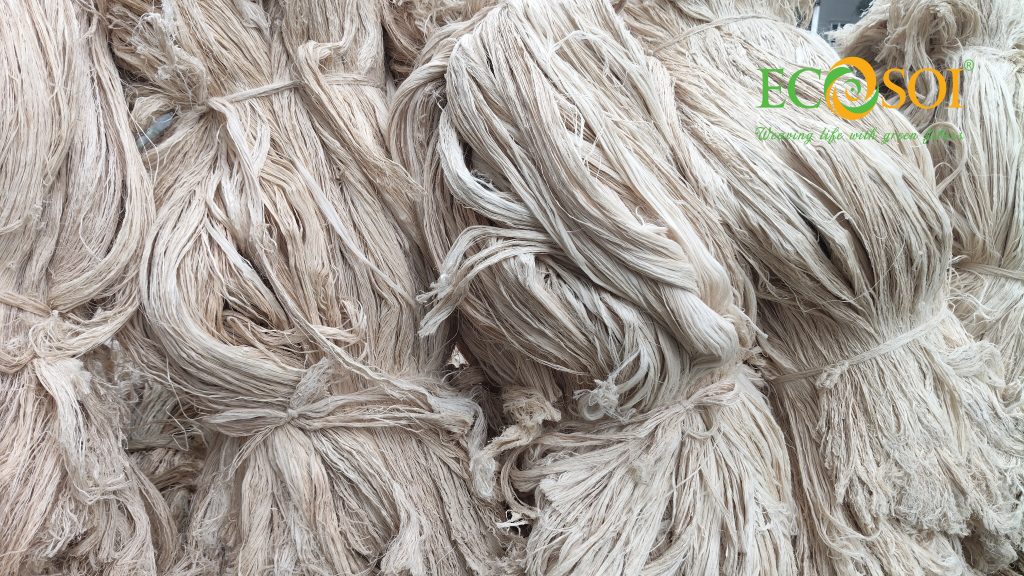
This context highlights why pineapple leaf fiber attracts industry interest. Ecosoi refines fibers from post-harvest pineapple leaves, turning agricultural waste into raw fiber, blended yarns, and finished textiles. Workers extract raw fibers mechanically. In addition, selected lines undergo clean water washing and natural sun-drying.
Ecosoi aims to lower emissions by reducing open-field leaf burning and saving energy during processing. However, two points must remain clear. Upcycling agricultural waste offers a promising start, but it does not replace formal carbon accounting. To claim that a fabric cuts emissions by a specific percentage compared to another cloth, brands must present verified life cycle studies.
Moving from green claims to verifiable data
For apparel brands, mills, and sourcing managers, material procurement is changing fast. Buyers no longer ask simply whether a fiber is green. Instead, they ask for verifiable proof:
- What is the exact fiber composition?
- Where do the raw crops come from?
- Which processing methods were used?
- Are there audited water and energy logs?
- Are chain-of-custody papers available?
- Is there an LCA study or third-party carbon report?
- What is the exact boundary of the provided data?
Asking these precise questions protects businesses from accidental greenwashing.
Do everyday consumers need to track carbon footprints?
Shoppers do not need to calculate emission numbers for every piece of clothing. However, understanding that garments create impact at every stage helps guide better daily choices:
- Buy fewer pieces and wear them longer.
- Choose clothes that fit practical daily needs.
- Value fabric durability over vague marketing stories.
- Check brand claims carefully instead of trusting basic eco tags.
Ultimately, a garment delivers real value only when people wear and cherish it for years.
Conclusion: Look beyond simple emissions numbers
A carbon footprint serves as a vital tool to evaluate how products impact global climate change. However, carbon data alone does not tell the entire sustainability story.
Within textiles, we must examine the complete path: raw materials => factory processing => logistics => daily use => end of life. At the same time, brands must clearly separate marketing buzz from verified scientific metrics.
For innovative options like pineapple leaf fiber, the discussion should move beyond natural origin claims. Instead, businesses should ask how fibers are processed, how many emissions they generate, and which data sets verify those claims.
Ecosoi supports brands on this exact path. We help partners understand how sustainable materials create tangible value for their products and corporate climate goals.
If you are exploring pineapple leaf textiles for an upcoming project, examine Ecosoi pineapple yarns and blended fabrics to evaluate real production samples.
👉 Contact Ecosoi today: Request your material sample kit and discuss practical, data-backed solutions for your next collection.