 VIETNAMESE
IS THE SUSTAINABILITY OF PINEAPPLE FIBER DECIDED BY MATERIALS OR PROCESSING?
Pineapple fiber is currently a highly popular bio-material choice. In the eco-textile industry, experts praise this material because it comes from agricultural waste. However, the modern textile value chain shows major differences. Not every type of pineapple fiber on the market is equally eco-friendly.
This situation raises a core question for both businesses and consumers. Does the sustainability of pineapple fiber come from the natural nature of raw input materials? Or does this factor depend entirely on factory processing methods during mass production?
This is not a purely technical question. Furthermore, it is a key issue related to material transparency. Clarifying this question helps build effective sustainable communication strategies. As a result, the modern fashion industry can eliminate vague assumptions.
Nội dung chính:
PINEAPPLE FIBER – BIOLOGICAL ADVANTAGES FROM RAW INPUT MATERIALS
Natural origin and renewability
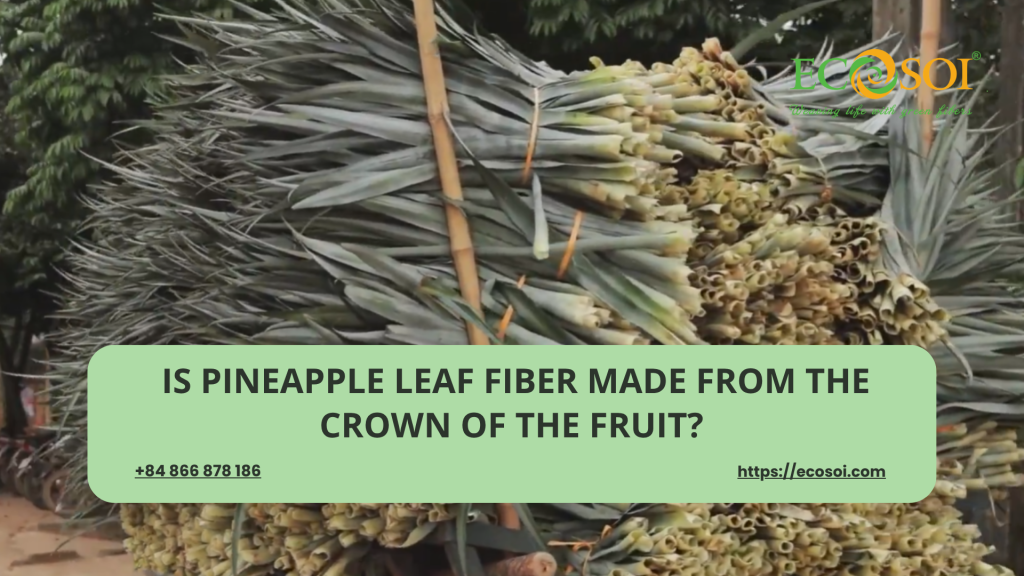
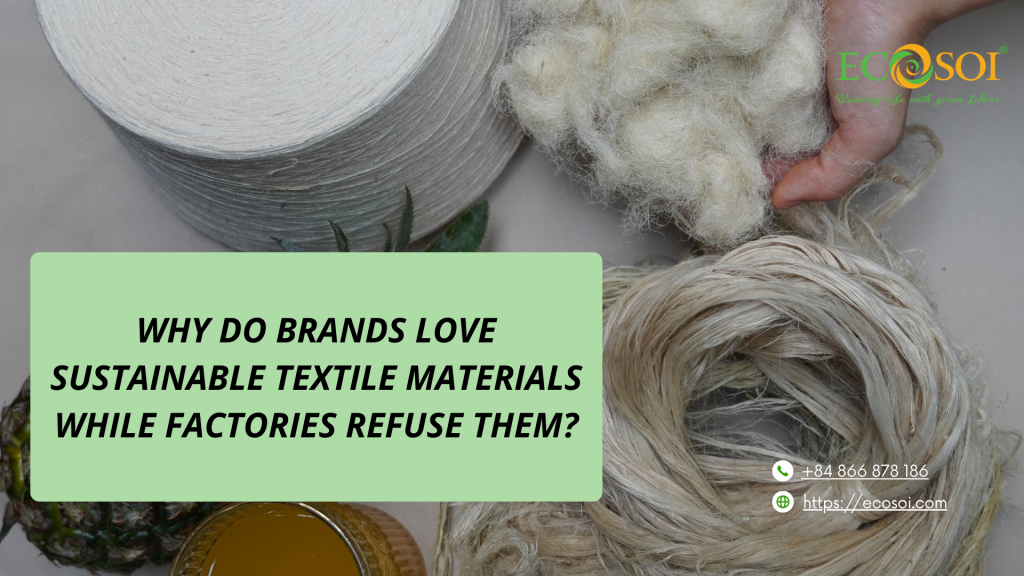
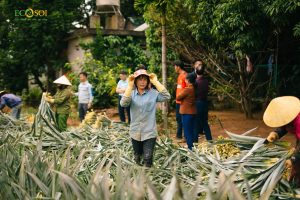
Biologically, farmers harvest pineapple fiber directly from pineapple leaves. This is a large source of by-products left behind after each fruit harvest. According to circular economy principles, utilizing this resource brings real values.
- First, it does not create pressure to expand agricultural land areas.
- Second, it avoids encroaching on natural forests for cultivation.
- Additionally, it significantly reduces the amount of organic waste decomposing freely in nature.
- Moreover, it limits the burning of agricultural waste, which causes local pollution.
- Finally, it optimizes added economic value for the eco-agricultural chain.
From this perspective, the raw material already holds a huge sustainable advantage. It is clearly superior to synthetic fibers made from fossil resources.
However, material experts always note one important thing. This advantage only exists at an initial “potential” level. Therefore, it cannot fully reflect the complete lifecycle of the material.
Green raw materials do not equal sustainable finished products
A common misunderstanding in the market today is equating concepts. Many people believe that if a product has a biological origin, the finished item is automatically sustainable.
In reality, raw material origin is only the starting point of the value chain. The process of transforming raw fiber into textile yarn can consume massive amounts of fossil energy. For example, factories will leave negative consequences if they overuse strong chemicals. A lack of clear traceability also reduces the yarn’s value. In that case, the original sustainability of pineapple fiber will definitely disappear.
PINEAPPLE FIBER PROCESSING: THE VALUE-SHAPING FACTOR IN THE SUPPLY CHAIN
From raw fiber to textile yarn: a huge technological gap
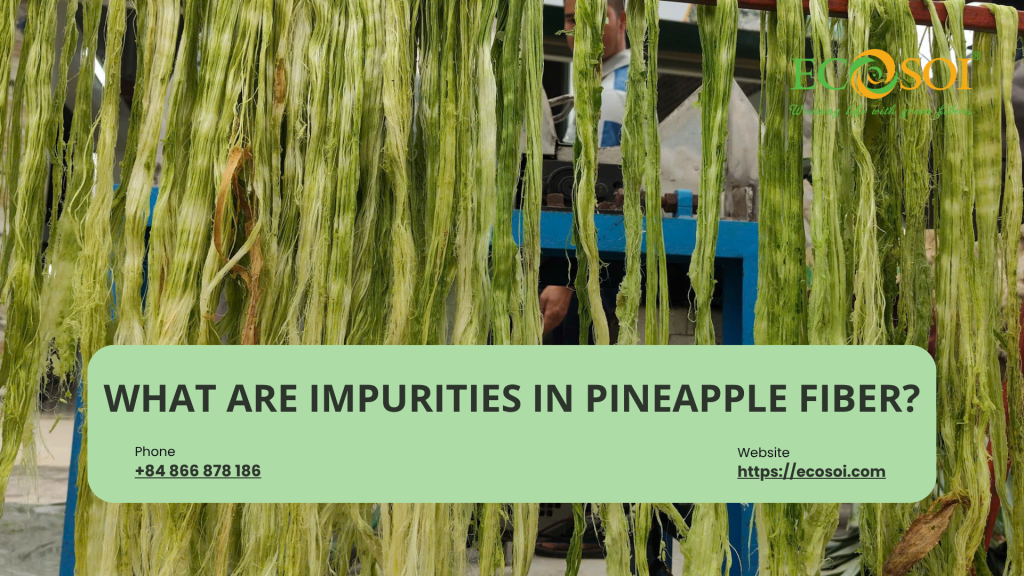
To apply coarse fibers smoothly on industrial weaving machines, the material must undergo deep processing. Workers must separate the fibers from the leaves before cleaning them. The greatest environmental impacts will arise during this specific manufacturing phase. Because of this, businesses must control three indicators strictly:
- Total water consumption during washing, softening, and degumming steps.
- Energy consumption levels of the operating machinery system.
- The list and concentration of chemicals applied in the cleaning process.
Consequently, the fiber processing method plays a critical, decisive role. It directly affects the eco-friendliness of the finished pineapple yarn. At the same time, it shapes the physical and mechanical quality stability of the fabric.
Differences between processing technology solutions
With the same input source of pineapple leaves, different processing technologies will lead to opposite results. They create a big difference in fiber characteristics and application capabilities. This explains why there is a clear division in the current market. Some lines reach a high level of fineness suitable for premium apparel. Meanwhile, other fiber sources remain limited to coarse applications like accessories or furniture.
However, you need to remember an important principle. All detailed comparisons regarding the environmental performance of processing technologies are only scientifically valid with clear data. This data must rely on a transparent Life Cycle Assessment (LCA). Without this database, any claim about “green” technology becomes empty.
MATERIALS OR PROCESSING: WHICH FACTOR HOLDS THE DECIDING ROLE?
From a material science perspective, we can give a clear and practical answer for the textile industry. The sustainability of pineapple fiber does not belong to a single independent factor. Instead, it is the inevitable result of a close combination of two elements. First, the raw input materials must meet high standards. Second, the production line must apply responsible processing solutions throughout the chain.
If a business has good materials but applies outdated processing, chemicals will destroy the initial biological advantage. Conversely, even the most optimal processing line has certain limits. It cannot turn a raw material heavily reliant on chemical fertilizers into a truly green material. Therefore, sustainability does not exist in a single stage. It lies in the consistency of the entire linked system.
A SUPPLY CHAIN PERSPECTIVE FOR B2B BUSINESSES
For businesses and fashion brands in the global textile supply chain, material selection must meet practical criteria. You need to know clearly which region workers harvest this pineapple fiber from. Additionally, you should check how the factory applies processing technology. Finally, you must ask to what extent the brand can trace the item.
For this reason, long-term material developers like Ecosoi always approach pineapple fiber with a systems mindset. Ecosoi does not view pineapple fiber purely as a raw material for sale. Instead, we build it into a vital link in the textile material ecosystem.
In that system, we standardize every stage and maintain data transparency for B2B partners. Our control steps range from partnering with farmers to harvest leaves, applying chemical-free mechanical extraction, to supplying textile yarn solutions.
HOW SMART CONSUMERS CAN AVOID MATERIAL GREENWASHING TRAPS
To protect personal interests and contribute to the environment, consumers should grasp the following principles:
- Understand that the name “pineapple fiber” only represents a biological origin. It does not reflect the whole sustainability picture of the finished clothing.
- Care actively about how fashion brands explain their production processes. You should not just look at vague “Eco” labels.
- Prioritize and support brands that practice information transparency. They must publish independent certifications of their material supply chain to prevent material greenwashing.
Equipping yourself with this correct perspective will help eliminate false expectations. Furthermore, you can make shopping decisions that fully match true sustainable fashion values.
CONCLUSION: SUSTAINABILITY LIES IN “AND”, NOT “OR”
In conclusion, the sustainability of pineapple fiber is not determined by raw materials alone. This factor does not belong solely to the processing method either. On the contrary, it is an obligatory intersection between two conditions. Those are a properly harvested agricultural by-product AND a responsible manufacturing process throughout the product lifecycle.
This system thinking is the guiding compass helping textile businesses make accurate material choices. It also supports brands in executing honest communication to avoid greenwashing risks. Meanwhile, consumers can approach sustainable fashion trends in the most realistic and scientific way.
ECOSOI COMPREHENSIVE MATERIAL SOLUTIONS INFO BOX
At Ecosoi, we solve the sustainability puzzle through a close combination of two factors. Those are standard raw input materials and responsible deep processing technology. By utilizing abundant pineapple leaf resources at Vietnamese farms, combined with an advanced mechanical separation process that minimizes chemical intervention, Ecosoi proudly delivers optimal sustainable materials. Our products offer stable physical properties, transparency, and clear traceability.
Explore more: Shop – ECOSOI – Weaving life with green fibers
Textile businesses and fashion brands looking for standardized green material solutions, please connect with Ecosoi’s technical department. We are ready to cooperate and send next-generation eco-fiber samples to you.
Connect with Ecosoi here